Medical materials · News
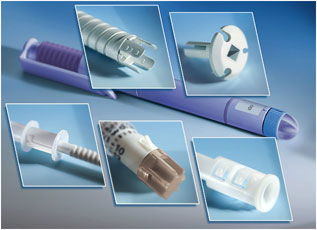
BASF Functional and mechanical components for insulin pen
These medical elastomers can replace thermoset rubber used for tiny plunger tips or seals that prevent drugs in the tube or barrel of the syringe from flowing backward as the plunger is depressed. Their good COF also…
These medical elastomers can replace thermoset rubber used for tiny plunger tips or seals that prevent drugs in the tube or barrel of the syringe from flowing backward as the plunger is depressed. Their good COF also eliminates coating requirements that might otherwise interact with drug contents of syringes.
These materials also exhibit lower oxygen absorption than nonvulcanizate TPEs (thermoplastic elastomers), thereby affording greater protection of pharmaceutical contents when used in seals or gaskets for vials. They also exhibit greater resilience than other TPEs, perform well in high-temperature end uses, are more chemical-resistant and can be sterilized in steam, autoclave, or gamma irradiation processes.
Continuing, polybutylene terephthalate (PBT) resin tailored for medical device dimensional accuracy is another innovative medical material use example. BASF's Ultradur B4520 PRO is a recently introduced PBT for injection-molded applications in medical technology. Its high dimensional stability and optimized shrinkage behavior meet the stricter reproducible dimensional accuracy requirements for medical device components. Other property features are as follows:
Sterilized with ionizing gamma radiation or ethylene oxide
Broad chemical resistance to polar and non-polar solvents
Ideal sliding, due to high friction and wear resistance (depending on the sliding partner)
Functional and mechanical components with high dimensional precision and stability for use in drug delivery systems such as insulin pens, inhalers or metering devices
Device components such as manifolds, screws, sleeves, valves, plungers, lancets or caps
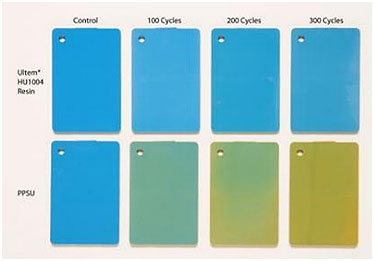
Next, polyetherimide (PEI) resisting H2O2 gas plasma sterilization is an interesting medical plastics material advance. A transparent, high-temperature thermoplastic, PEl resin blend Ultem HU 1004 from Sabic Innovative Plastics with improved impact resistance and enhanced hydrostability has been developed for healthcare applications. Recent tests show that this medical-grade PEI resists hydrogen peroxide (H2O2) gas plasma sterilization better than polyphenylsulfone (PPSU) another amorphous high temperature engineering thermoplastic.
There is growing interest in this newer sterilization technique - known commercially as Sterrad NX, a tradename of Advanced Sterilization Products. Because this new sterilization technique is a dry, low-heat process, it can be used to sterilize sensitive electrosurgical devices such as cameras.
Ultem HU1004 (top row) shows almost no color change from
100 to 300 Sterrad NX cycles, while PPSU (bottom row)